If you have been referred for a colonoscopy, the preparation is probably what concerns you most. The preparation is the least pleasant part, but modern options are far more manageable than you might expect. The procedure itself, under sedation, you will not feel at all.
Digestive endoscopy. It is the only thing we do — for over 40 years. Three dedicated rooms, teams that do nothing else, over 3,000 procedures a year.
Why choose our service
Pioneer endoscopy service in Barcelona
3 HD-equipped rooms
Painless procedure
Results before you leave
What is a colonoscopy?
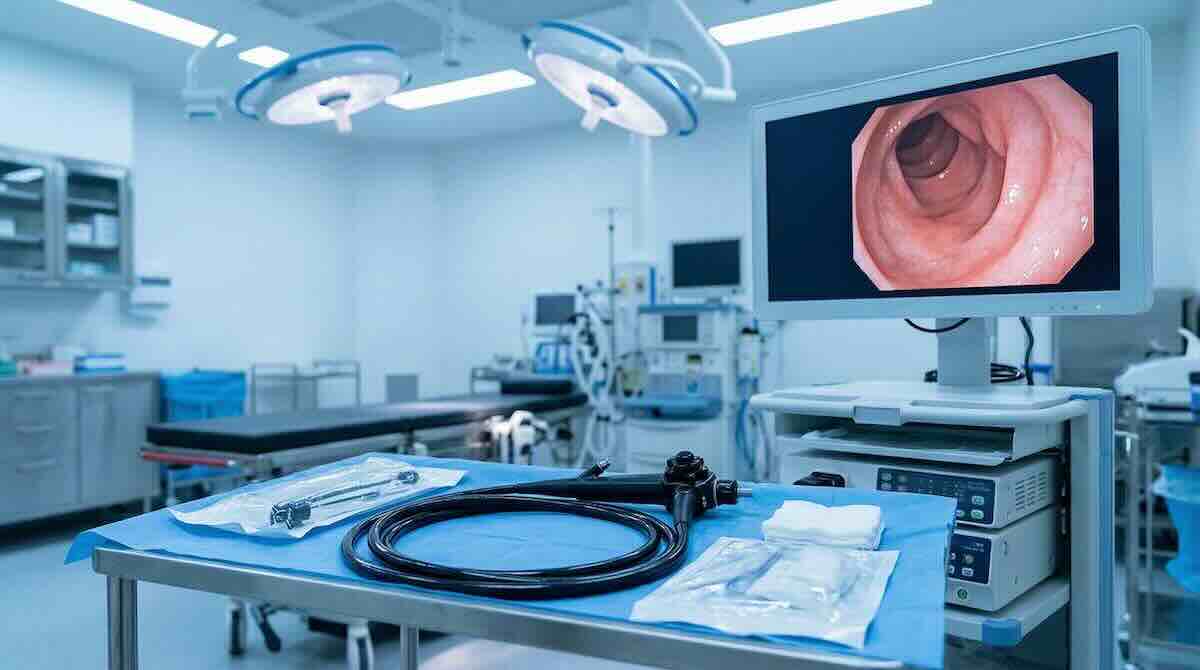
Colonoscopy is an examination of the large intestine (colon) and rectum using a colonoscope: a flexible tube approximately 1.5 metres long with an HD camera at the tip. If a polyp is detected, it can be removed during the same procedure (polypectomy), without surgery.
Does a colonoscopy hurt?
With sedation, colonoscopy is painless. Sedation is the standard for all colonoscopies in our service — not an option to request. Most patients have no memory of the procedure.
When do I need a colonoscopy?
On medical referral (diagnostic):
- Blood in stools — visible or positive FOBT
- Persistent change in bowel habit for more than 4–6 weeks
- Persistent lower abdominal pain
- Iron-deficiency anaemia without identified cause
- Diagnosis or monitoring of IBD (Crohn's, ulcerative colitis)
- Post-polypectomy or post-surgery surveillance
Preventive screening (no symptoms):
- From age 45–50, colorectal cancer screening
- From age 40 (or 10 years before a relative's diagnosis) if there is a first-degree family history
Preparation: how to do it well
- 3 days before — Low-residue diet. No fruit, vegetables, pulses, wholegrains, nuts, juices or fizzy drinks. You can eat: meat, chicken, fish, rice, pasta, strained broths, eggs, white bread, yoghurts, skimmed milk, coffee, tea.
- The day before — Switch to a liquid diet: strained broths, strained juices, herbal infusions, water, gelatine (no dark colouring).
- Pleinvue laxative (split-dose):
- Morning colonoscopy: 1st dose at 19:00 the night before · 2nd dose at 21:00.
- Afternoon colonoscopy: 1st dose at 08:00 on the day · 2nd dose at 10:00 (finish before 12:00).
- On the day — Complete fasting after finishing preparation. Come with a companion.
Tip: Drink the preparation cold. Take breaks between glasses if nauseous. Preparation is correct when stools are completely liquid and clear, like lemonade.
Important medication: Ozempic, Mounjaro or Wegovy — stop 15 days before. Saxenda: 7 days before. Iron or fibre: 7 days before. Anticoagulants, diabetes or heart medication — notify the service in advance.
The procedure, step by step
- Arrival — Arrive 30 minutes early. Nursing staff welcome you and take vital signs.
- Intravenous access — A cannula is placed for sedation.
- Sedation — Administered. Within a minute, you fall asleep.
- Procedure (20–45 minutes) — The colonoscope examines the entire colon. Polyps found are removed on the spot.
- Recovery — Sedation wears off in 15–30 minutes.
- Results — Report handed to you within minutes.
Total time at hospital: 2 to 3 hours.
What happens if a polyp is found?
It is removed during the same procedure (polypectomy) using a snare or forceps through the colonoscope — no incisions, no surgery. The polyp is sent to pathology (results in 7–10 days), which determines the type, grade of dysplasia and follow-up interval.
After colonoscopy
- Possible bloating: normal, resolves within hours. Walking helps.
- You can eat approximately 1 hour later, starting with light foods.
- Do not drive for 12–24 hours after sedation.
- Small traces of blood in the first stools after polypectomy: normal in small amounts.
Risks and safety
- Intestinal perforation: fewer than 1 in 1,000 diagnostic colonoscopies
- Post-polypectomy bleeding: 1–2%, generally self-limiting
- Gas, bloating, drowsiness: resolve spontaneously
After polypectomy: Avoid strenuous exercise, aspirin and anti-inflammatory drugs for 48 hours.
Health insurance and authorisations
We work with the major private health insurers: Sanitas, Adeslas, Asisa, DKV, Aegon, Allianz, AXA, Agrupació Mútua, Caser, Cigna, Divina Pastora, Línea Directa, Vivaz, HNA, MUSA, MGC, Mutua Granollers, Mutua Manresana and Occident.
Authorisation: Request written authorisation from your insurer using code 618 (Sanitas: code 8515). Send authorisations to our email at least 2 days before the procedure.
Divina Pastora or Occident: request that the anaesthetist is listed as "CONSTITUCIÓN ANES".
Morning sessions:
endoscopias.bcn@quironsalud.es
Afternoon sessions:
endodigestiva.bcn@quironsalud.es
Frequently asked questions
The procedure lasts 20 to 45 minutes. Total time at hospital is 2 to 3 hours.
With sedation the procedure is painless. Most patients have no memory of it.
Low-residue diet for 3 days, liquid diet the day before, then Pleinvue in two split doses. See our full preparation guide.
It is removed on the spot (polypectomy). It is sent for analysis to determine the follow-up needed.
From age 45–50 without risk factors. With first-degree family history, start 10 years before the relative's age of diagnosis.
The endoscopy report is handed to you within minutes. Pathology results take 7–10 days.
It is possible but not recommended. Without sedation it can be uncomfortable and is less effective at detecting lesions.
The major insurers cover colonoscopy with code 618 (Sanitas: 8515). Call +34 93 219 26 58 for guidance.
The procedure is covered by major private health insurers in Spain: Sanitas, Adeslas, Asisa, DKV, Aegon, Allianz, AXA and many more. We also see private-pay and international patients with a prior quote. Call +34 93 219 26 58 to check your coverage.