If you have been referred for a gastroscopy, it is natural to have questions. This page explains exactly what will happen — from preparation to recovery. No small print.
Digestive endoscopy. It is the only thing we do — for over 40 years. Three dedicated rooms, teams that do nothing else, over 3,000 procedures a year.
Why choose our service
Pioneer endoscopy service in Barcelona
3 HD-equipped rooms
Painless procedure
Results before you leave
What is a gastroscopy?
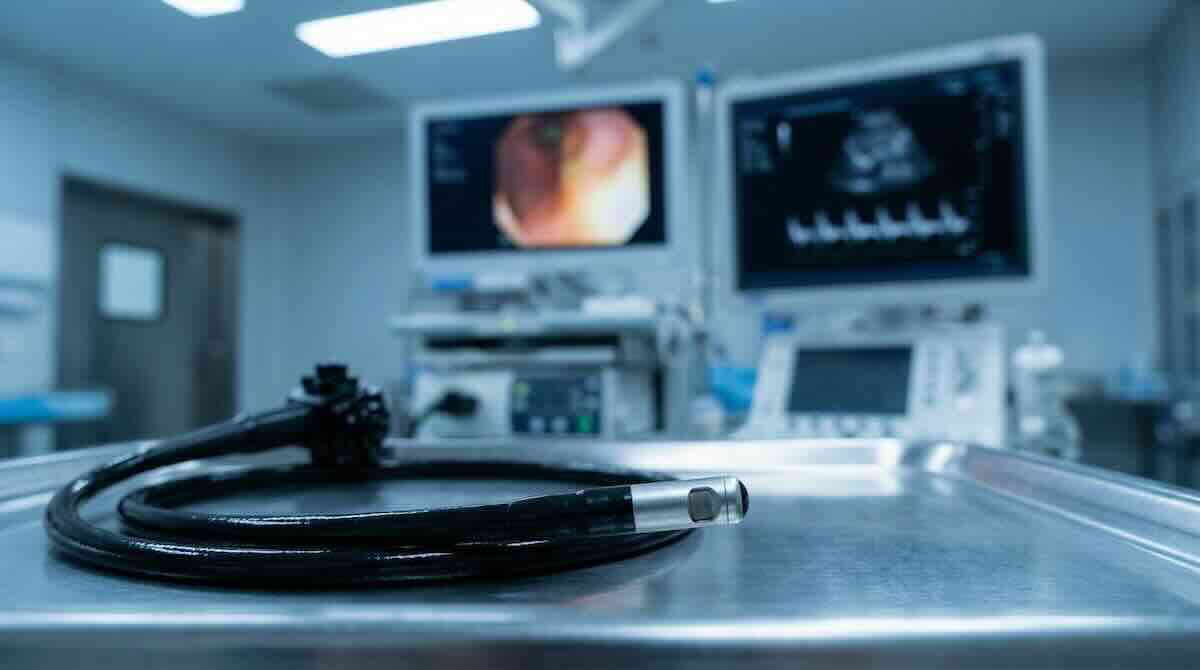
Gastroscopy (also called upper digestive endoscopy) is the most direct and reliable examination of the oesophagus, stomach and duodenum. It uses a gastroscope: a flexible tube with an HD camera at the tip.
In a single procedure, the endoscopist can directly visualise the digestive mucosa, take biopsies, detect Helicobacter pylori, remove small polyps (polypectomy) and treat bleeding lesions. Gastroscopy is both diagnostic and therapeutic.
All gastroscopies at our service are performed under sedation. The procedure lasts 10 to 15 minutes and is painless.
Does a gastroscopy hurt?
Gastroscopy is performed under sedation, meaning the patient remains in deep relaxation throughout. The procedure is painless and most patients have no memory of it whatsoever. Sedation is the standard in our service — not something you have to request.
When is a gastroscopy needed?
- Persistent heartburn or acid reflux not improving with treatment (GORD)
- Pain or discomfort in the upper abdomen lasting more than 4 weeks
- Difficulty swallowing (dysphagia)
- Frequent vomiting or blood in vomit
- Significant unexplained weight loss
- Iron-deficiency anaemia without identified cause
- Diagnosis or follow-up of Barrett's oesophagus
- Suspected Helicobacter pylori infection
- Family history of gastric cancer
Preparation for gastroscopy
Complete fasting for 8 hours. No food, drink or medication — including water.
- Come with a companion — required (you cannot drive for 12–24 hours after sedation)
- Arrive on time for your appointment
- Bring: your referral and insurance card
Medication adjustments
| Medication | Instruction |
|---|---|
| Anticoagulants, antiplatelets, Aspirin | Notify the service in advance |
| Diabetes or heart medication | Notify the service in advance |
| Oral iron or fibre supplements | Stop 7 days before |
| Saxenda | Stop 7 days before |
| Ozempic, Mounjaro or Wegovy | Stop 7 days before |
| Pacemaker carrier or latex allergy | Notify the service |
The procedure, step by step
- Arrival and reception — Nursing staff check your details, take vital signs and review allergies.
- Intravenous access — A cannula is placed for sedation.
- Mouth guard — A small plastic piece protects your teeth.
- Sedation — Administered intravenously. Within a minute, you fall asleep.
- Procedure (10–15 minutes) — The endoscopist passes the gastroscope through your mouth and examines the oesophagus, stomach and duodenum. Biopsies or therapeutic procedures are performed if needed.
- Recovery — Sedation wears off in 10–20 minutes in the recovery room.
- Results — Your report is handed to you within minutes.
Total time at hospital: approximately 1.5 to 2 hours.
What might the endoscopist find?
- Gastritis — inflammation of the stomach lining. Generally treatable with medication.
- Reflux oesophagitis — oesophageal damage from stomach acid (grades A–D).
- Hiatus hernia — common, usually requires no specific treatment.
- Gastric or duodenal ulcer — often associated with H. pylori.
- Barrett's oesophagus — requires periodic monitoring.
- Helicobacter pylori — detected via biopsy (results in 7–10 days).
- Gastric polyps — removed during the same procedure if small.
After gastroscopy
- You can eat approximately 1 hour later. Start with liquids.
- Mild sore throat for 24–48 hours: normal, resolves on its own.
- Possible bloating: normal, resolves within hours.
- Do not drive for 12–24 hours after sedation.
Your endoscopy report is handed to you within minutes. Pathology results (if biopsies taken) take 7–10 days.
Risks and safety
Diagnostic gastroscopy is very safe. Serious complications are exceptional: fewer than 1 in every 1,000 procedures. Common mild effects (sore throat, bloating, drowsiness) resolve spontaneously.
Health insurance and authorisations
We work with the major private health insurers: Sanitas, Adeslas, Asisa, DKV, Aegon, Allianz, AXA, Agrupació Mútua, Caser, Cigna, Divina Pastora, Línea Directa, Vivaz, HNA, MUSA, MGC, Mutua Granollers, Mutua Manresana and Occident.
Authorisation: Request written authorisation from your insurer using code 617 (Sanitas: code 8514). Send authorisations to our email at least 2 days before the procedure.
Divina Pastora or Occident: request that the anaesthetist is listed as "CONSTITUCIÓN ANES".
Morning sessions:
endoscopias.bcn@quironsalud.es
Afternoon sessions:
endodigestiva.bcn@quironsalud.es
Frequently asked questions
The procedure itself takes 10 to 20 minutes. Total time at hospital is 1.5 to 2 hours.
Yes, using a throat spray, but the experience is far less comfortable. In our service, sedation is the standard.
Complete fasting for 8 hours — no food, drink or medication, including water.
No medication during the 8-hour fast. Notify the service in advance if you take anticoagulants, diabetes or heart medication, or weight-loss injections.
Approximately one hour after waking from sedation. Start with liquids.
Yes, if you receive sedation. You cannot drive for 12 hours afterwards.
Yes. Biopsies can be taken during gastroscopy to detect it (results in 7–10 days).
Yes. Small polyps can be removed during the same procedure (polypectomy) and sent for analysis.
The endoscopy report is handed to you within minutes. Pathology results take 7 to 10 days.
Yes. You come, have the examination, recover and go home the same day. Total time: 1.5 to 2 hours.
The procedure is covered by major private health insurers in Spain: Sanitas, Adeslas, Asisa, DKV, Aegon, Allianz, AXA and many more. We also see private-pay and international patients with a prior quote. Call +34 93 219 26 58 to check your coverage.