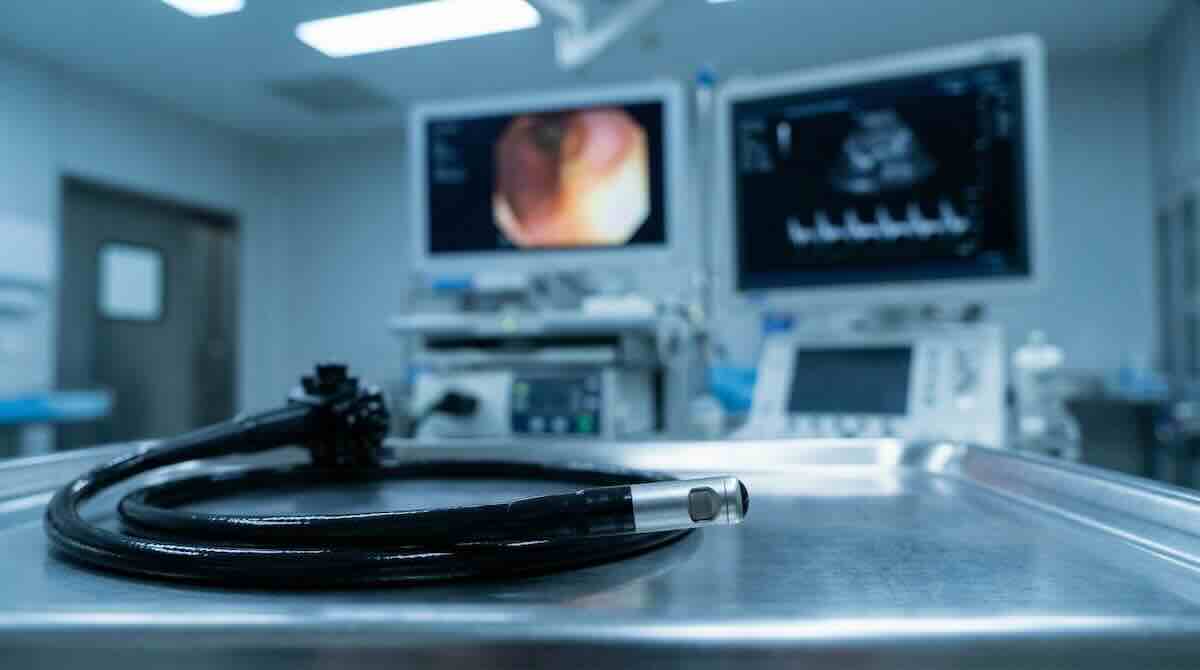
If your doctor has referred you for an endosonography, you have probably searched for information without finding much that helps. It is not the most well-known procedure, but for certain problems of the pancreas, bile ducts and oesophagus, it is the most precise examination available.
Digestive endoscopy. It is the only thing we do — for over 40 years. Three dedicated rooms, teams that do nothing else, over 3,000 procedures a year.
What is endosonography (EUS)?
Endosonography combines endoscopy and high-frequency ultrasound in a single instrument. The echoendoscope generates ultrasound images of the organs adjacent to the digestive tract — pancreas, bile ducts, liver, lymph nodes — with a resolution that no external scanner can achieve.
What is endosonography used for?
Pancreatic evaluation:
- Diagnosis and staging of pancreatic cancer
- Evaluation of pancreatic neuroendocrine tumours
- Characterisation of pancreatic cystic lesions
- Guided fine-needle aspiration (FNA) for definitive diagnosis
Bile duct evaluation:
- Detection of choledocholithiasis — more precise than MRCP and without radiation
- Evaluation of biliary strictures
- Staging of gallbladder and bile duct cancer
Digestive wall evaluation:
- Characterisation of subepithelial tumours (GIST, lipomas, leiomyomas)
- Local staging of oesophageal and gastric cancer
How is the procedure performed?
Similar to gastroscopy: 6-hour fast, sedation, 20–45 minutes duration.
What are the risks?
Diagnostic EUS has a safety profile similar to gastroscopy. FNA tissue sampling adds a minimal risk of bleeding or pancreatitis (below 2%).
Frequently asked questions about endosonography
EUS combines endoscopy with high-frequency ultrasound. Unlike gastroscopy, which only visualises the internal surface, EUS allows imaging of organs surrounding the digestive tract — pancreas, bile ducts, lymph nodes — with very high resolution.
Between 20 and 45 minutes, depending on whether tissue sampling is performed. Total time at hospital is 2 to 3 hours.
No. It is performed under sedation, just like gastroscopy. The patient does not feel the procedure.
The same as for gastroscopy: complete fasting for at least 6 hours. If tissue sampling is to be performed, anticoagulant medication may need to be adjusted.
FNA allows tissue samples to be obtained from pancreatic lesions, lymph nodes or other deep structures guided by real-time ultrasound. It is fundamental for confirming diagnoses such as pancreatic cancer.
For certain indications, yes. EUS detects smaller pancreatic lesions than CT and allows tissue sampling in the same session — something conventional imaging cannot do.
Yes. EUS is a specialist procedure requiring a referral from a doctor, usually a gastroenterologist or oncologist.
EUS is covered by the major insurers we work with. Call +34 93 219 26 58 to verify your specific coverage.
For patients from abroad and their doctors
Endoscopic ultrasound at the Digestive Endoscopy Unit
Endoscopic ultrasound is not available at most centres. This is the information usually needed when arranging one in Barcelona.
- Tertiary-level experience. The unit is led by Dr Jordi Armengol Bertrolí, Head of Service, who also practises at the Endoscopy Unit of Vall d'Hebron University Hospital, with a focus on complex and therapeutic procedures.
- Complex cases. Staging of digestive lesions, assessment of subepithelial lesions, pancreatobiliary disease, and fine-needle aspiration when indicated.
- Full hospital back-up. The procedure is performed inside Hospital Quirónsalud Barcelona, with anaesthesiology, radiology, surgery, inpatient care and ICU on site — no transfers.
- Coordination with your own doctor. The endoscopy report is handed over on the day and can be sent to the doctor who requested the test, including your doctor at home, who remains in charge of your follow-up.
- Quick scheduling. Self-paying patients do not depend on insurer pre-authorisation; an appointment is usually available within a few days.
To discuss a case or arrange a procedure: +34 93 219 26 58, Monday to Friday, 8:00–20:00 (CET).
Has your doctor referred you for an endosonography? You can call the service directly.
+34 93 219 26 58Direct line to the service · Monday to Friday, 8:00–20:00