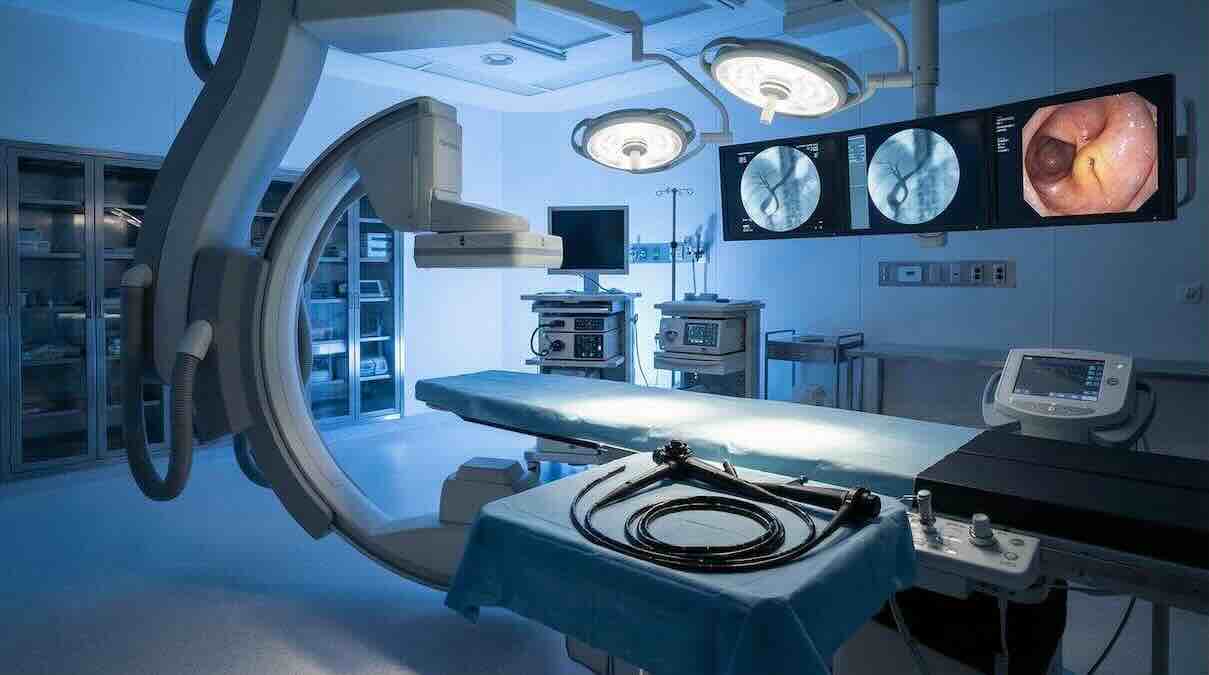
If you have been told you have stones in the common bile duct — the duct connecting the gallbladder to the intestine — ERCP is likely the procedure that will spare you surgery. In most cases, treatment is completed in a single endoscopic session.
Digestive endoscopy. It is the only thing we do — for over 40 years. Three dedicated rooms, teams that do nothing else, over 3,000 procedures a year.
What is ERCP?
Endoscopic Retrograde Cholangiopancreatography combines endoscopy with fluoroscopy (real-time X-ray) to visualise and treat the bile and pancreatic ducts from inside the duodenum. A duodenoscope is advanced to the duodenum, the ampulla of Vater is located and, guided by radiological contrast, obstructions, stones or strictures are identified and treated.
When is ERCP needed?
- Choledocholithiasis — stones in the common bile duct: the most common indication
- Biliary strictures — narrowing of the common bile duct, treated with a stent
- Acute cholangitis — serious bile duct infection
- Biliary pancreatitis — prevention of recurrence
- Post-surgical bile leak
How is ERCP performed?
Preparation: 6-hour fast. Deep sedation.
The procedure (30–90 min): Duodenoscope advanced to duodenum → ampulla of Vater located → biliary duct accessed → contrast injected → sphincterotomy → stone extraction or stent placement. All from inside, without any external incision.
What are the risks of ERCP?
- Post-ERCP pancreatitis — 3–5%, generally mild
- Post-sphincterotomy bleeding — 1–2%
- Perforation — <0.5%
Recovery
ERCP requires hospital admission. The patient is admitted on the day of the procedure and remains for observation. Length of stay depends on procedure complexity and clinical progress.
Frequently asked questions about ERCP
Yes. ERCP is performed under deep sedation administered by an anaesthesiologist. The patient remains asleep throughout.
In the majority of cases of common bile duct stones, yes. ERCP allows stones to be removed and biliary obstruction resolved without open or laparoscopic surgery.
The most frequent risk is post-ERCP pancreatitis (3–5%), generally mild. Other minor risks include bleeding and perforation. In a specialist service these risks are minimised.
Yes. The patient is admitted on the day and remains for observation. Length of stay depends on procedure complexity.
Yes. ERCP is always indicated by a specialist — usually a gastroenterologist or surgeon — after prior investigation confirming the need.
Yes, the major private health insurers cover ERCP. Call +34 93 219 26 58 to verify your coverage.
For patients from abroad and their doctors
ERCP at the Digestive Endoscopy Unit
ERCP is a therapeutic procedure that calls for experience, volume and full hospital back-up. This is the information usually needed when arranging one in Barcelona.
- Tertiary-level experience. The unit is led by Dr Jordi Armengol Bertrolí, Head of Service, who also practises at the Endoscopy Unit of Vall d'Hebron University Hospital, with a focus on complex and therapeutic procedures.
- Complex cases. Difficult cannulation, anatomy altered by previous surgery, complex bile-duct stones, and placement or exchange of biliary and pancreatic stents.
- Full hospital back-up. The procedure is performed inside Hospital Quirónsalud Barcelona, with anaesthesiology, radiology, surgery, inpatient care and ICU on site — no transfers.
- Coordination with your own doctor. The endoscopy report is handed over on the day and can be sent to the doctor who requested the test, including your doctor at home, who remains in charge of your follow-up.
- Quick scheduling. Self-paying patients do not depend on insurer pre-authorisation; an appointment is usually available within a few days.
To discuss a case or arrange a procedure: +34 93 219 26 58, Monday to Friday, 8:00–20:00 (CET).
Has your doctor referred you for an ERCP? You can call the service directly.
+34 93 219 26 58Direct line to the service · Monday to Friday, 8:00–20:00